Baptism Day 2026!
Acts 2:36-41
To do lists for dog lovers, the overwhelmed, and retired 😊
Dog Lover

Overwhelmed

Retired

Repentance
1. John the Baptist (Matt. 3:2; Mark 1:4; Luke 3:3, 8)
2. Jesus (Matt. 4:17; Mark 1:15; 2:17; Luke 5:32; 13:3, 5; 15:7; 17:3)
3. Peter (Acts 2:38; 3:19; 8:22; 11:18; II Pet. 3:9)
4. Paul (Acts 13:24; 17:30; 20:21; 26:20; Rom. 2:4; II Cor. 2:9–10)
More than remorse
An unknown author wrote, “There is a radical distinction between natural regret and God-given repentance. The flesh can feel remorse, acknowledge its evil deeds, and be ashamed of itself. However, this sort of disgust with past actions can be quickly shrugged off, and the individual can soon go back to his old wicked ways."
Our Daily Bread, Monday, July 16
Repentance: That mighty change in mind, heart, and life, wrought by the Spirit of God.
— Richard Trench, Archbishop of Dublin
The verb “repent” is plural, and so is the pronoun “your” in the clause so that your sins may be forgiven (lit. “unto the remission of your sins,” eis aphesin tōn hamartiōn hymōn). Therefore, the verb “repent” must go with the purpose of forgiveness of sins. On the other hand, the imperative “be baptized” is singular, setting it off from the rest of the sentence.
Repentance by definition is not an act separate from trusting Christ. It is part of the process of believing. When a person trusts Christ, he or she abandons his or her false notions about the Savior and embraces the truth.
There is a difference between conviction and condemnation. Romans 8:1
“Conviction of sin is one of the rarest things that ever strikes a man. It is the threshold of an understanding of God. Jesus Christ said that when the Holy Spirit came He would convict of sin, and when the Holy Spirit rouses the conscience and brings him into the presence of God, it is not his relationship with men that bothers him, but his relationship with God.” Oswald Chambers
(Vs. 38 “for the remission of sins” )
It means because of the remission of sins. The Greek preposition “eis”, for, has this meaning “because of”
Word pictures in the New Testament III., pp. 35-36
Other Biblical Baptisms:
Jesus’ Baptism
Jesus came from Galilee to be baptized by John at the Jordan. After his baptism, he emerged from the water, and the heavens opened with the Spirit of God descending like a dove while the Father declared him his beloved Son. (Matt 3:13–16) Mark records that Jesus was baptized in the Jordan by John. (Mark 1:9)
Early Church Baptisms in Acts
On Pentecost, about 3,000 people were baptized after accepting Peter’s message. (Acts 2:41) Both men and women were baptized when they believed Philip’s preaching about the kingdom of God and Jesus Christ. (Acts 8:12–13) Philip baptized an Ethiopian eunuch after they came to water along the road. (Acts 8:36–38) Paul was baptized immediately after his conversion experience. (Acts 9:18) Peter commanded Gentiles to be baptized in the name of Jesus Christ after they received the Holy Spirit. (Acts 10:47–48) Lydia and her household were baptized. (Acts 16:15) A Philippian jailer and his entire family were baptized the same night. (Acts 16:33) Many Corinthians believed and were baptized when they heard Paul’s message. (Acts 18:8) Disciples at Ephesus were baptized in the name of the Lord Jesus. (Acts 19:5)
KJV Acts 2:37 “Now when they heard this, they were pricked in their heart”
“Prick” means “to cut”; infers pain and deep anguish. Homer used this word to depict horses stomping the earth with their hooves.
Page 44, The Book of Acts by Dr. Johnny Hunt 2008 3H Publishers, Woodstock, Georgia
The idea of an un-baptized believer does not seem to be in the New Testament.
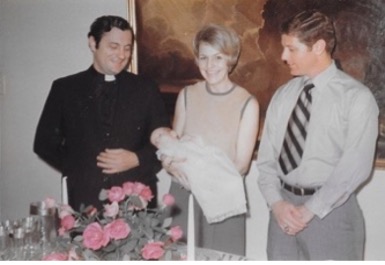
Father Dubois; Acadian Parish, Louisiana
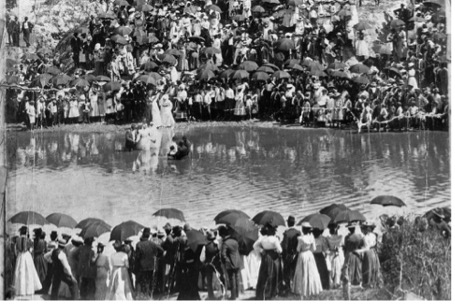
Baptism in Buffalo Bayou, early 1900’s
Baptist History: Felix Manz and Conrad Grabel
Protestant Reformation: 1517
Around 1519, became a followers of Huldrych Zwingli after he came to Zürich
Grebel, Manz and others made several attempts to plead their position against required infant baptism. Several parents refused to have their children baptized.
On 7 March 1526, the Zürich council had passed an edict that made adult re-baptism punishable by drowning. On 5 January 1527, Manz became the first casualty of the edict, and the first Swiss Anabaptist to be martyred at the hands of magisterial Protestants. While Manz stated that he wished "to bring together those who were willing to accept Christ, obey the Word, and follow in His footsteps, to unite with these by baptism, and to purchase the rest in their present conviction", Zwingli and the council accused him of obstinately refusing "to recede from his error and caprice". At 3:00 p.m., as he was led from the Wellenburg to a boat, he praised God and preached to the people. A Reformed minister went along, seeking to silence him, and hoping to give him an opportunity to recant. Manz's brother and mother encouraged him to stand firm and suffer for Jesus' sake. He was taken by boat onto the River Limmat. His hands were bound and pulled behind his knees and a pole was placed between them. He was executed by drowning in Lake Zürich on the Limmat. His alleged last words were, "Into thy hands, O God, I commend my spirit."
Baptism by Randy Travis:
The summer breeze, made ripples on the pond
Rattled through the reeds and the willow trees beyond
Daddy in his good hat, mama in her Sunday dress
Watched in pride, as I stood there in the water up to my chest
And the preacher spoke about the cleansing blood
I sank my toes into that East Texas mud
And it was down with the old man, up with the new
Raised to walk in the way of light and truth
I didn't see no angels, just a few saints on the shore
But I felt like a new baby, cradled up in the arms of the Lord
Amazing grace, oh how sweet the sound
There was glory in the air, there was dinner on the ground
And my sins went for many, were washed away and gone
Along with a buffalo nickel I forgot to leave at home
But that seemed like such a small, small price to pay
For the blessed peace of mind that came to me that day
And it was down with the old man, up with the new
Raised to walk in the way of light and truth
I didn't see no angels, just a few saints on the shore
But I felt like a new baby, cradled up in the arms of the Lord
This road is long and dusty, sometimes the soul must be cleansed
And I long to feel that water, rushing over me again
Down with the old man, up with the new
Raised to walk in the way of light and truth
I didn't see no angels, just a few saints on the shore
But I felt like a new baby, cradled up in the arms of the Lord
I felt like a newborn baby, cradled up in the arms of the Lord
History:
The trajectory of baptism from the apostolic period to the present reveals a complex evolution, particularly regarding the inclusion of infants—a practice that emerged early but without clear historical documentation of its origins.
Early Christian Practice (1st–2nd centuries)
The New Testament itself contains no explicit instance of infant baptism, though household baptisms mentioned in Acts (such as the Philippian jailer’s) may have included children[1]. Early Christian documents from the first and early third centuries emphasize the baptism of adult believers or children old enough to understand preparatory instruction[1]. However, Tertullian’s late second-century writings against infant baptism suggest the practice was already occurring by that time[1].
The Emergence of Infant Baptism (2nd–3rd centuries)
Origen, who was baptized in infancy, explicitly traced the custom to apostolic tradition, stating that “the Church has received the tradition from the apostles to give baptism to little children”[2]. By the mid-third century, Bishop Cyprian connected infant baptism with Old Testament circumcision and advocated baptizing infants within days of birth[1]. Notably, Tertullian opposed infant baptism on grounds of expediency rather than apostolic impropriety, never suggesting it was a post-apostolic innovation[2].
Universalization and Theological Rationale (3rd–4th centuries)
By the third century, no evidence exists of any church refusing to baptize infants[3]. The theological basis for infant baptism centered on its efficacy in cleansing sin and ensuring regeneration[4]. Yet the practice was not uniformly applied; many Christian leaders from Christian families delayed baptism into adulthood, including Ambrose (baptized at thirty-four) and Basil the Great (around twenty-five)[1].
Medieval Period to Reformation
Infant baptism remained unquestioned in the Church until the Petrobrusians emerged around 1130, and no significant organized opposition appeared until German Anabaptists arose in 1522[4]. From that point forward, the practice became a defining point of theological division between Protestant and Catholic traditions and various reform movements.
[1] Ian J. Shaw, Christianity: The Biography (Grand Rapids, MI: HarperCollins, 2017), 36.
[2] Samuel Macauley Jackson, ed., in The New Schaff-Herzog Encyclopedia of Religious Knowledge (New York; London: Funk & Wagnalls, 1908–1914), 1:451.
[3] S. M. Merrill, Christian Baptism: Its Subjects and Mode (Cincinnati; New York: Hitchcock and Walden; Nelson & Phillips, 1876), 142.
[4] John M’Clintock and James Strong, “Pædobaptism,” in Cyclopædia of Biblical, Theological, and Ecclesiastical Literature (New York: Harper & Brothers, Publishers, 1894), 7:525